


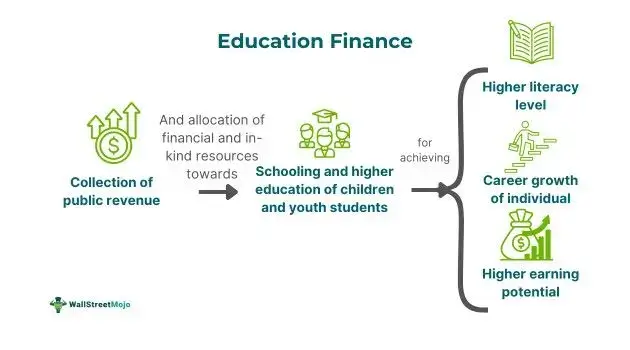
What is Education Finance? Education finance refers to the financial and in-kind resources available for the provision of education. Moreover, this domain addresses considerations regarding the mechanisms by which resources are allocated, utilized, and accounted for, with the objective of achieving sustainable, quality education for all children and youth.
Table of Contents
Key Takeaways
- Education finance refers to government and institutional funding that supports schooling and higher education.
- It promotes equal access, quality education, and long-term sustainability across regions.
- Common funding options include student loans (private and federal), grants, scholarships, and work-study programs.
- Strong education finance policies ensure public funds are used effectively to support individual and economic growth.
Education Finance Explained: Meaning, Scope, and Global Role
Education finance refers to the systems and policies through which governments and institutions fund schooling and higher education for children and youth. It involves mobilizing public revenue from taxes, tuition fees, and philanthropic contributions to build and maintain educational facilities, institutions, and learning resources. With support from global organizations such as the World Bank, UNESCO’s International Institute for Educational Planning, and the Global Partnership for Education (GPE), countries design education finance policies to expand access to education and improve literacy outcomes worldwide. The core principles guiding education finance include equity, quality, efficiency, and regional balance across education systems.
According to the Education Finance Watch (EFW) 2023 report, education spending trends up to 2021 show that low-income countries increased total education expenditure following the COVID-19 pandemic, largely driven by higher government funding, which made up about half of total spending. However, this increase was not sufficient to fully close learning gaps created during the pandemic. The report, jointly produced by the World Bank, the Global Education Monitoring Report, and the UNESCO Institute for Statistics, draws on data from major global sources including the World Bank, UIS, IMF, and OECD to highlight ongoing challenges and priorities in global education financing.
Types of Education Financing Options for Students
Students can choose from several funding options to manage their education expenses. The most common types of education financing include:
- Private Student Loans: Offered by banks, credit unions, and other financial institutions to support higher education. These loans typically have higher interest rates and fewer repayment protections compared to federal loans.
- Federal Student Loans: Government-backed loans that help students fund their education through graduation. They include Direct Subsidized and Direct Unsubsidized Loans, which generally offer lower interest rates and more flexible repayment options.
- Work-Study Programs: Programs designed to help students earn income while studying by working part-time, usually on or near their school campus, to cover education-related costs.
- Scholarships and Grants: Financial aid provided by federal, state, and local governments, educational institutions, and private organizations. These awards are typically based on financial need, academic merit, or special achievements and do not require repayment.
Example 1: Need-Based Scholarship for International Higher Education
Ayaan, a student from Kenya, completed his undergraduate degree in economics and planned to pursue a master’s program in data analytics at a public university in Europe. Due to limited family income, covering tuition and living expenses was challenging. To fund his studies, Ayaan combined a government-backed student loan with a merit-based university scholarship. This mix of education financing allowed him to continue his education while managing repayment through a structured, income-based plan after graduation.
Example 2: World Bank–Led Global Education Financing Initiatives
Several emerging economies have recently introduced education finance reforms to address low literacy rates among primary school students. In one such initiative, a Southeast Asian country redirected a portion of its digital services tax revenue toward public education, increasing per-student spending and teacher training programs. As a result, school enrollment improved and reading proficiency among children aged 8–10 showed measurable gains within a few years. This approach highlights how strategic education financing can transform education from a recurring cost into a long-term national investment.
Why Education Finance Matters: Key Benefits and Impact
Education finance plays a vital social and policy-driven role in supporting schooling and higher education. Its importance can be understood through the following key benefits:
- Efficient Resource Mobilization: Education finance helps governments and international institutions allocate financial and non-financial resources effectively to strengthen education systems.
- Responsible Use of Public Funds: Well-designed education finance policies ensure that public revenue is used efficiently to support social and economic development.
- Supports Career Achievement: Access to education funding enables individuals to complete their studies, build relevant skills, and pursue clear career pathways.
- Encourages Personal Growth: Education finance promotes lifelong learning, contributing to personal development and positive social outcomes for families and communities.
- Improves Access and Affordability: By reducing financial barriers, education finance makes quality education more accessible to people from all income levels and supports additional academic needs where required.
- Strengthens Employment Opportunities: Better access to education leads to a more skilled workforce, improving job creation, employability, and wage potential.
- Increases Long-Term Earning Potential: Since education is closely linked to income growth, sustained investment in education finance helps individuals achieve higher earnings over time.
Frequently Asked Questions (FAQs)
1. Why should financial education be taught in schools?
Financial education helps students understand budgeting, saving, debt, and investing from an early age. Teaching these skills in schools prepares young people to make informed financial decisions, avoid excessive debt, and manage money responsibly throughout their lives.
2. How are student loan payments calculated?
Student loan payments are typically calculated based on the loan amount, interest rate, and repayment term. Federal loans may also use income-driven repayment plans, where monthly payments are adjusted according to the borrower’s income and family size.
3. Why is financial education important?
Financial education empowers individuals to manage money effectively, plan for the future, and reduce financial stress. It improves decision-making related to loans, savings, credit, and investments, leading to greater financial stability and long-term economic well-being
4. How can I apply for education financing to pay for college tuition?
You can apply for education financing by completing government financial aid applications (such as federal student aid forms), applying for scholarships and grants, or requesting student loans from banks and financial institutions. Many colleges also offer financial aid offices to guide students through the process.
5. Which companies offer student loan refinancing services in the US?
Several private lenders provide student loan refinancing in the US, including SoFi, Earnest, Credible, Laurel Road, and CommonBond. These companies allow borrowers to refinance existing student loans, often to secure lower interest rates or better repayment terms.


