

Did you know? Over 1.5 million merit scholarships go unclaimed yearly because students don’t apply. Don’t miss out, here’s how to find awards tailored to you. Scholarships can significantly reduce the cost of graduate or college education. Merit based scholarships, as opposed to need-based aid, which is determined by family income, honor your achievements, skills, and potential.
Key Takeaways
- Many merit scholarships go unclaimed simply because students don’t apply.
- Merit-based scholarships reward skills, achievements, and talent, not income.
- Finding the right awards requires self-assessment and targeted searching.
- Strong, well-prepared applications significantly improve winning chances.
- Staying organized and applying widely increases overall success.
5 Steps to Find Merit Scholarships
There are awards that are specific to your strengths, whether you are a standout student, athlete, artist, or member of your community. We’ll go over every stage of the procedure in this tutorial, from evaluating your abilities to submitting a successful application. In addition to providing examples for both domestic students (such as the Gates Scholarship or National Merit) and overseas students (such as Fulbright, DAAD, or Chevening programs), we will do it in an approachable and practical manner.
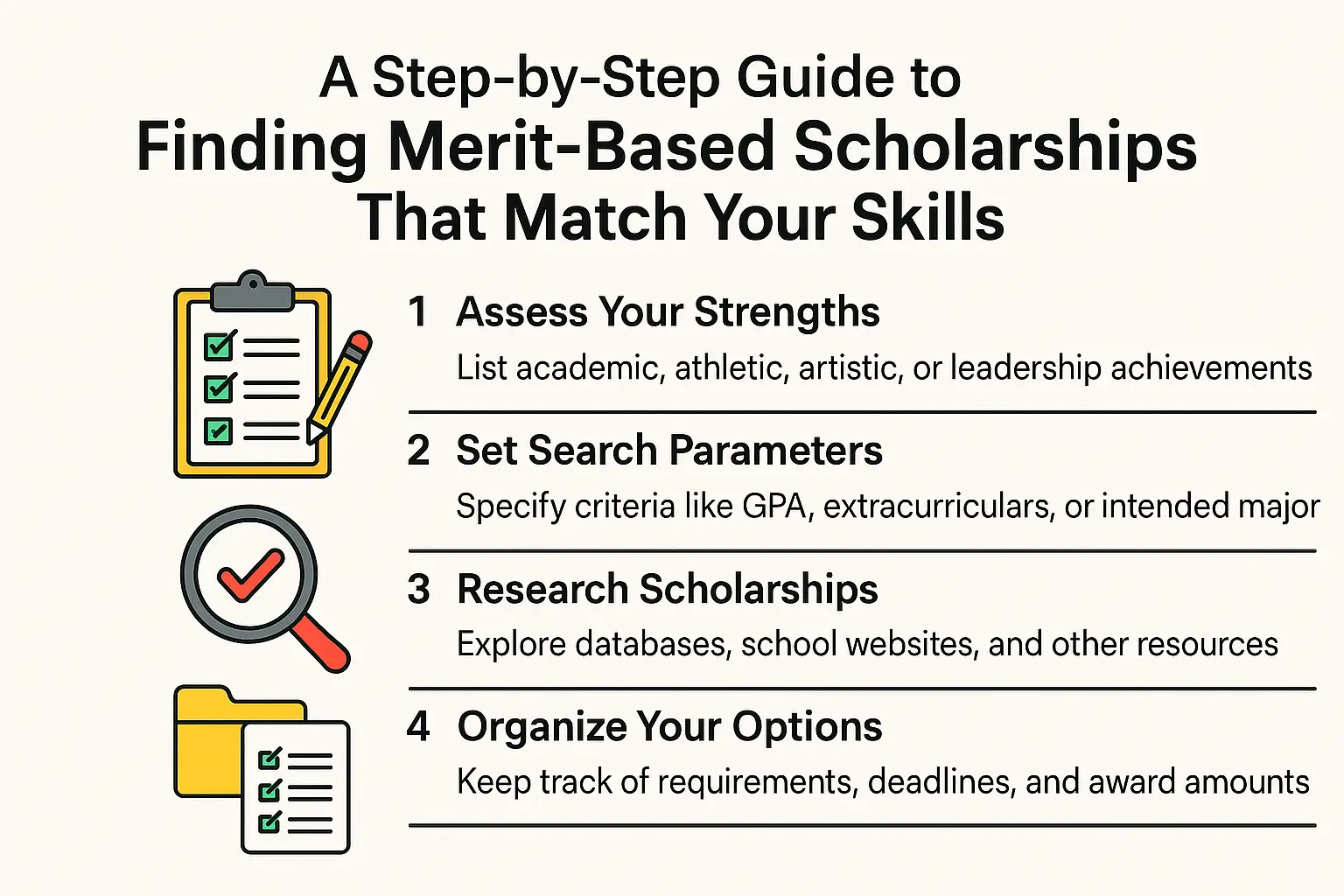
Here is a A Step-by-Step Guide to Finding Merit Based Scholarships That Match Your Skills Let’s dive in.
Step 1: Identify What You’re Good At and What You Love
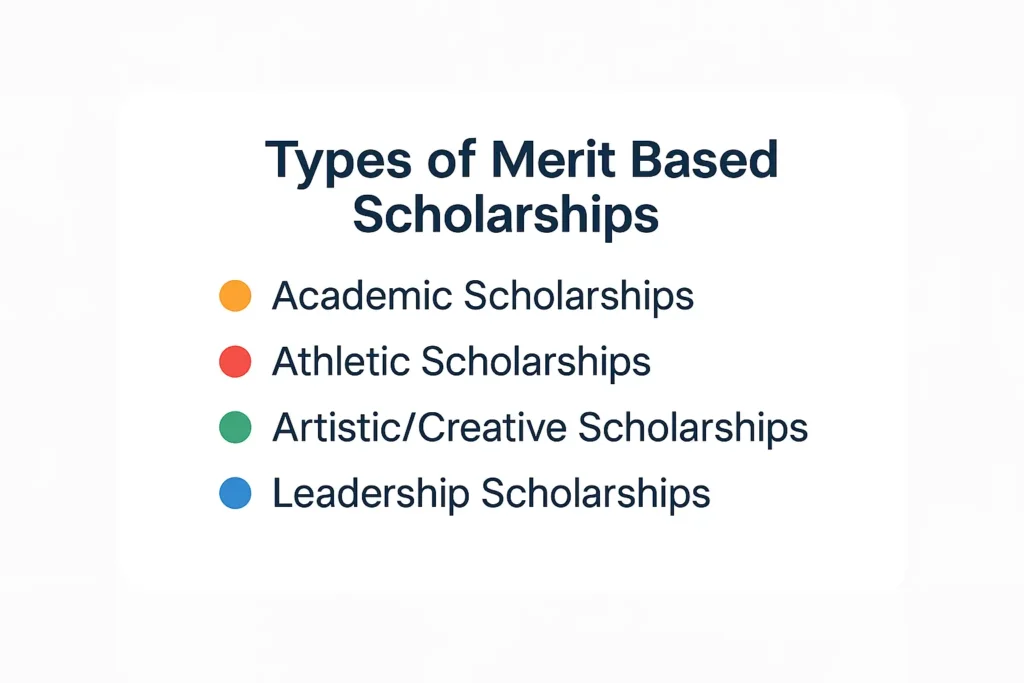
Start by assessing your strengths and areas of passion. The secret to locating the best scholarships is your own abilities. Do you excel academically, as seen by your excellent SAT/ACT scores, AP/IB courses, and top grades? A gifted artist (musician, writer, painter, etc.)? A sportsman with accolades? Or a volunteer in the community and a born leader? Be truthful and detailed. Students are advised to undertake “an honest assessment of your strengths, passions, special talents, and other characteristics that set you apart,” for instance, in one college preparation book.
List your accomplishments, including your GPA, test results, awards from scientific fairs, debates, or math competitions, leadership positions (club president, team captain, or student government), creative achievements (concerts, exhibitions, or published writings), and more. Asking your family, friends, or teachers what they think are your best traits is another option. This self-awareness will assist you in identifying scholarships that are in line with your qualifications.
- Academic strengths: You can tell by looking at your test results (SAT/ACT, AP, IB), class rank, and transcript. Take note of AP/IB courses and prizes, such as math contests.
- List recitals, art exhibits, writing competitions, or portfolios as examples of artistic abilities.
- Athletic accomplishments: Keep track of any league titles, state competitions, or team MVP honors.
- Leadership and service: List volunteer hours, leadership honors, club officer positions, or service initiatives.
You can determine which scholarship areas to concentrate on by evaluating your strengths. The first step to making an impression on scholarship applications is to think about what makes you special.
Step 2: Use the Best Sources Online and Locally
to Search for Scholarships
Finding the right scholarships requires casting a wide net. Use multiple resources to discover opportunities that fit your profile. Key places to search include:
- School and University Financial Aid Pages: Start by deciding the programs or colleges you want to attend. On their financial aid websites, the majority of institutions list their institutional scholarships, which are frequently the biggest rewards. For instance, whereas some universities require a separate application, others evaluate applicants for merit scholarships immediately. Verify the GPA requirements and deadlines.
- Online Scholarship Databases: Make accounts on the main search engines for scholarships. You can find thousands of scholarships through websites like Fastweb, Scholarships.com, Cappex (now Scholly or others), and specialist portals. After you provide your background, they recommend awards for which you are eligible. Both local and national scholarships can be found in these databases.
- Local and Community Organizations: Small scholarships should not be overlooked. Awards are frequently given out with less competition by civic associations, local companies, community foundations, and religious institutions. Look for bulletin boards or newsletters at your local library or high school guidance office. Scholarship programs are frequently offered by community organizations like the Elks Club, Rotary, etc. Awards for employees’ children may even be offered by employers (parents or your own part-time job).
- Professional and Corporate Scholarships: Scholarships are funded by numerous businesses and trade associations. For instance, scholarships are provided by Google, Coca-Cola, and technical societies for specific majors or groups. Look for scholarships offered by their workplace if you know someone in that field. National professional associations can be invaluable resources, such as engineering societies or state bar associations for law students.
- High School and Guidance Resources: Teachers and school counselors can help you locate scholarships that aren’t available online. They frequently keep track of lists of regional and national honors, including ones that are tailored to certain clubs, such as NHS or FFA. Additionally, they can offer guidance on which scholarships fit your profile.
- International/Government Programs: Look into government-funded scholarships if you live outside of the United States or are considering studying abroad. For instance, international students can enroll in graduate schools in the United States under the Fulbright Foreign Student Program. Global leaders can pursue one-year master’s degrees through the UK’s Chevening Scholarships. Thousands of scholarships that cover living expenses for studying in Germany are available through Germany’s DAAD. Look into the scholarship organizations in the nation where you want to study. Programs by nation are frequently included on EducationUSA/UK websites.
- General Web Search: Lastly, try specific keywords in Google or Bing. Use phrases like “scholarships for music composition students [your country]” or “STEM scholarships international” to highlight your qualifications and location. Scholarship information is also listed on websites such as CollegeEssayGuy and BigFuture (College Board).
Utilize a combination of these resources to find both well-known and obscure scholarships. To stay organized, note where each opportunity came from (see Step 6).
Step 3: Double-Check If You Qualify Before Applying
Don’t ignore the fine print if you’ve found a scholarship that seems promising. Meeting the eligibility requirements for each prize is crucial. Nationality or place of residence, minimum GPA, planned major, skill level, or leadership experience are examples of common requirements. Before you spend time applying, make sure you are eligible. For example, only Pell-qualified (low-income) U.S. citizens or permanent residents with an excellent academic record are eligible for the Gates Scholarship. A program like Gates won’t apply to you if you’re an international student, but Fulbright and Chevening (discussed above) are programs specifically for non-U.S. citizens.
Practical advice: Make a note of or highlight each criterion. Make a short list of “Must Haves” (GPA ≥ X, X year completed, Y citizen, etc.). For instance, make a note of the precise requirements if a scholarship calls for a 3.5 GPA, a leadership essay, and financial need. For clarification, get in touch with the scholarship organizer. “Each scholarship has specific eligibility requirements,” a site on scholarship strategy informs us. Before applying, it is essential to carefully review the eligibility requirements. This avoids wasting time on awards that aren’t eligible.
Additionally, be mindful of the due dates for every component. Take note of any early nomination dates (such as National Merit Semifinalists) and if applications must be submitted electronically or by postal mail. On your calendar, note each of these dates (refer to Step 6). You can avoid hassles later by carefully reading the eligibility conditions now.
Step 4: Build a Strong, Standout Application
Transcripts, essays or personal statements, recommendation letters, and proof of your achievements (portfolios, test results, and award lists) are all required for the majority of merit scholarship applications. Here’s how to differentiate yours:
- Plan Ahead: Allow enough time to create each component. According to one instruction, “Avoid putting things off! Allow enough time to go over and revise your essay. Weeks or months before the due date, finish your essays and gather resources in case you need to make changes.
- Write a Stellar Essay or Personal Statement: You have the opportunity to share your tale in the essay. Share your objectives, interests, and reasons for deserving of the scholarship in it. Be sincere and intent. According to some advice, you should ask yourself: Who are you? What do you hope to accomplish? Why is this scholarship necessary for you? How is it going to benefit you? Edit for clarity after writing. Pay close attention to spelling and grammar; errors can detract from a well-written essay. Have a mentor or instructor look it over. Keep in mind that the essay is your opportunity to express your demands, achievements, objectives, etc. After reading your essay, the scholarship reviewers ought to feel as though they know you well. Make the most of that familiarity, but avoid giving away too many unimportant things.
- Gather Transcripts and Scores: Use test score reports or ask your school for official transcripts. Verify that they are current and, if necessary, formally sealed. While some awards merely require GPA, others require complete transcripts. Pay close attention to the directions.
- Request Recommendation Letters: A lot of merit scholarships require one to three letters from mentors, educators, or local authorities. Select individuals who are familiar with you in the relevant field (e.g., a mentor for leadership awards, a coach for sports awards, or a math teacher for academic scholarships). Make your request as early as possible (at least one month prior to the due date), and give each recommender a copy of your accomplishments or a “ask form” so they can emphasize the appropriate aspects. Your application can be greatly strengthened by a solid letter of recommendation.
- Compile a Resume or List of Achievements: Although not strictly necessary, a concise résumé or list of activities will assist reviewers in quickly assessing your qualifications. Add accolades, organizations, sports, occupations, and interests.
- Polish and Double-Check: Review every application component. Follow all formatting guidelines (font size, word limits, number of copies). Make sure you include all requested forms. As one source advises, after writing your essay, go back and “read it for content and organization. At this point, it is probably too long, what can you eliminate or incorporate?”. Finally, ensure your application is neat: type or print clearly, label each part, and attach documents as instructed.
Applying your best efforts here is vital because scholarship committees “want to ensure that the funds go to students who are committed”. By planning ahead, writing clearly, and proofing carefully, you’ll present yourself as a strong, organized candidate.
Step 5: Get Organized to Stay on Track
Keeping track of multiple scholarships can be overwhelming. Stay on top of deadlines and requirements to avoid last-minute panic. Here are some organization tips:
- Create a Scholarship Tracker: Use a spreadsheet or a dedicated notebook. For each scholarship, list key info: name, sponsor, due date, required materials, essay topics, and contact info. Update it as you go. This ensures you won’t forget a deadline or miss a required form.
- Set Calendar Reminders: Input deadlines into a calendar app (with alerts a week or two before). Also note any interim deadlines (like interview dates for finalists).
- Use Checklists: For each application, make a checklist of “to-dos” (e.g. write essay, get transcript, ask for letter) and tick them off as you complete them. This was recommended by a scholarship advice site: “Stay organized throughout the application process by creating a checklist and ensuring all required materials are submitted before the deadline.”
- Back Up Your Work: Keep copies of your essays and resume. If uploading online, confirm submission by printing or saving confirmation screens. If mailing anything, send via tracked mail and keep proof of mailing.
- Follow Up: After applying, note any interview or follow-up expectations. If contact info is given, you can politely confirm that your materials were received.
Being organized shows scholarship committees that you’re responsible (and it keeps you sane!). It also gives you time to handle any surprises. Remember, “start early” and “stay persistent,” as advisers stress. Applying for scholarships is often a numbers game—applying to many awards increases your chances. A little spreadsheet and some reminders go a long way toward catching every opportunity.
Step 7: Showcase Your Talent Based on Your Unique Profile
Finally, let’s wrap up with specific advice for each type of strength you might have, so you can highlight it in your applications:
- If You’re Academically Oriented: Emphasize grades, test scores, and challenging coursework. If you have Advanced Placement (AP), IB, or honors classes, mention them. Consider taking the PSAT seriously for National Merit qualification (since over 1.3 million U.S. students enter via PSAT each year). For college scholarships, mention any academic awards (summa cum laude, honor roll, subject Olympiad medals). In your essays, talk about your love of learning or a specific academic project.
- If You Shine in the Arts: Create a strong portfolio or audition tape. Include any competitions won or exhibitions held. When writing essays, tie your scholarship goals to your art—explain what drives your creativity. Look for scholarships from arts foundations (local arts councils, music conservatories) that match your discipline. Some global scholarships (like Fulbright) even have art and performance awards.
- If You’re an Athlete: Keep a sports resume with stats, records, and honors. Make sure your coaches know about your scholarship search; they can write good recommendations. Some athletic scholarships require quick responses (e.g., giving a verbal commitment by a certain date), so pay attention to sports-specific timelines. In your general scholarship essays, highlight teamwork, discipline, and leadership from sports (co-curricular strengths matter even for academic awards).
- If You’re a Leader or Volunteer: Emphasize roles and impact. Describe projects you initiated (community clean-up, charity drives, club events) and the difference you made. Leadership scholarships love concrete results (e.g., raised $X for charity, grew a club membership by Y%). Letters of recommendation from people who worked with you in leadership roles can be especially persuasive. Programs like Coca-Cola Scholars value community and leadership highly. Don’t forget to mention any national service awards (Prudential Spirit of Community, etc.) or elected positions.
Also Read everything you need to know dod smart scholarship
Final Though
Above all, be yourself and be proud of your talents. Scholarship committees are looking for genuine stories and accomplishments. By aligning your application with your true strengths, backed by the examples and resources in this guide, you put yourself in the best position to win the scholarships that fit you.
Finding the right merit based scholarship is a process of self-discovery and persistence. We hope this step-by-step guide helps you navigate it successfully.
Remember: start early, apply widely, and present the real you. Good luck on your scholarship journey!
Sources: We gathered advice from university scholarship guides and official scholarship program pages, including St. John’s University, College Board (National Merit), The Gates Scholarship website, EducationUSA on Fulbright, Chevening, DAAD, and scholarship strategy blogs. These informed the steps and tips above.